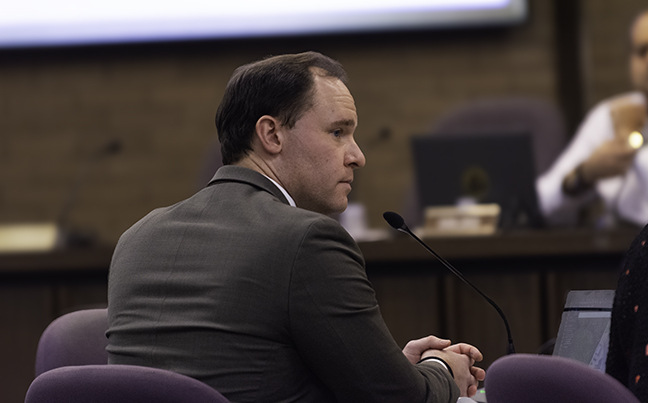
The second time proved to be the charm February 5 for a company that wants to create an outdoor commercial storage space on Route 27.
JC IOS Acquisitions won Zoning Board of Adjustment approval for the plan that ran into rough sledding at the Board’s January 8 meeting.
At that prior meeting, the Board expressed several concerns about the project, including fact that the plan submitted had been changed, but no updated plans were available. Board members also had questions about the types of materials that would be stored there, how high the material would be stacked, and how visible the site would be from Route 27.
JC IOS took care of that in the intervening weeks, project engineer Jeffrey Haberman told the Board. Haberman took the Board through the revisions made to the plan.
“So the first change that we’ve made to the site plan layout is eliminated some of the storage area that’s located closer to Route 27,” he said. “If you will recall, there were a number of stalls striped just to the top of Route 27, closer to the roadway.”
“We’ve eliminated that storage area, so we pulled the pavement back roughly 55 feet to provide an extra buffer screening area to provide a better visual impact from Route 27,” he said. “So that’s 55 feet of new lawn area that was placed there. We’ve also eliminated some of the existing concrete on the very top end of the site.”
“So with that, we did effectively reduce the impervious coverage down to 71.1%, which gets you closer to the conforming impervious coverage,” Haberman said. “Again, this is already in a non-conforming condition, whereas the existing site was at 78.6%. We’ve reduced it down from the initial submission to the last revision we presented at the last meeting, it was 74.5%. So we’ve taken it down even further to 71.1%. Over a four-acre site, it’s not a little bit of impervious. And the important part is that we pulled it away from Route 27, in my opinion, and provide some landscape screening along the front.”
“Secondly, we heard some concerns about site security,” Haberman said. “So what we show here … on the left property line … we are proposing an eight-foot high fence that’ll attach to the building … run along the left property line to the top and connect to an existing fence.”
“So that effectively provides better security, especially from the north and west,” he said. “The rest of the site … it’s wetlands, heavily vegetated. And to the right, you have the public works and other industrial uses, but you also have a fair amount of vegetation between those two uses as well.”
“So I believe this provides a nice secure site for the applicant to operate in the future,” he said.
Haberman also showed the Board how different materials or equipment could be stored on the site without impeding traffic flow through the site.
“It could be one tenant that could take the site, which is the preferred option, I think, from an operational perspective, but it could be split up,” he said.
Haberman’s example showed storage of buses, sprinter vans, and pickup trucks.
“So, all vehicles that could maneuver the site effectively,” he said.
The company also decided to not allow tractor trailer storage, Haberman said, and would instead keep the graveled areas empty.
Haberman said materials such as mulch or salt would be stored in precast concrete boxes.
“That way they’d have the ability to put tarp over it or something as well, in case you have a heavy wind, you know, the chunks or whatever, you know, anything over 50 miles an hour, it could end up blowing away,” he said. “So I think that that would be an effective solution for a landscaper that might want to tenant the site.”
A third area could be used to store construction vehicles and equipment, he said.
“So I wanted to give the board some comfort,” he said. “I know there’s many questions being, it’s an, I don’t want to say unusual, but an unrecognized use in many municipalities throughout New Jersey.”
Board Chairman Robert Thomas asked how, if there were multiple tenants, each tenant’s storage material would be kept separate.
“I want to be comfortable that you’re not telling me, you take this site and I pull my truck in and I just dump everything and I leave,” he said. “I wouldn’t want somebody next to me putting all their material where mine was.”
John Grib, JC IOS’s vice president, told the Board that “if we go the multi-tenant route … each tenant has a lease agreement where it specifies exactly what those premises are. So if somebody has the building, how much square feet for the yard, how much acreage typically or land square feet.”
“And then at the end of that lease agreement, you have an exhibit that outlines exactly where that tenant is going to operate,” he said.
Mark Healey, the Township’s Principal Planner, told the Board that the Township will review every potential tenant.
“Every time there’s a new commercial tenant, it has to get reviewed by staff,” he said. “So certainly as tenants come and go on this site, staff is going to want to look at the plan.”
“They’ll have to submit for a zoning permit for a change of tenant,” Healey said. “And we’ll have to see what they’re proposing, what type of use is it, a landscaper versus truck storage, whatever. We’re going to see how that basically manifests on this plan, showing that they’re maintaining those fire lanes. And if it’s going to be something like mulch or leaves or something like that, that they’re properly containing it. And they’ll have to address that over the years as the tenants come and go.”
Stay ‘In the Know,’ subscribe to the Franklin Reporter & Advocate!
No other media outlet covering Franklin Township brings you the depth of information presented by the Franklin Reporter & Advocate. Period. We are the only truly independent media serving the Eight Villages.
But we can only do that with your support. Please consider a yearly subscription to our online news site; at $37 a year, it’s one of the best investments you can make for yourself.
To subscribe, please click here.
The Franklin Reporter & Advocate Eight Villages, One Community