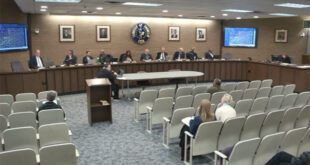
A series of design and location specifications designed to limit where in the township warehouses can be built – and how large they can be – was approved and passed on to the Township Council January 14 by the Planning Board in a special meeting.
If the Council follows the Planning Board lead, the specifications will become part of the Township Master Plan, and will limit warehouse sizes to no larger than 400,000 square feet.
The meeting was originally supposed to be held in April 2025. But, according to Planning Board chairman Michael Orsini, the Board wanted additional input on the then-proposed recommendations from the ad-hoc steering committee created to assist in the effort.
The ad-hoc committee was composed of residents and Township officials.
The purpose of the January 14 meeting was to conduct a public hearing on a proposed Master Plan Reexamination Report and proposed zoning ordinance changes to the Township’s Business-Industry Zone, affecting light industry in general and warehouses in particular.
The intended result is to confine light- and medium- use warehouses to certain parts of the BI Zone – away from residential areas – and to totally prohibit the construction of high-intensity warehouses.
The Township Council in 2023 passed an ordinance amendment that stripped any mention of warehouses from Franklin’s zoning documents. That removed the permitted and conditional use status from warehouses, and forced developers to go to the Zoning Board of Adjustment for a use variance.
But there were no design standards established, which is what the Master Plan Re-examination Report and proposed BI Zone changes would provide.
The ordinance separates warehouses into three groups: Low Intensity Light Industrial, which is a warehouse measuring up to 150,000 square feet and having fewer than one loading dock per 10,000 square feet; Medium Intensity Light Industrial, which is a warehouse measuring between 150,000 and 400,000 square feet and having fewer than one loading dock per 5,000 square feet, and High Intensity Light Industrial, which is a warehouse measuring more than 400,000 square feet, or having more than one loading dock per 5,000 square feet.
High-intensity warehouses tend to be used as fulfillment centers or delivery hubs.
The high-intensity warehouses would be outright banned, while the other two would be conditional uses, according to the ordinance.
Under the proposed ordinance, medium-intensity uses must be located within one mile of an Interstate Route 287 interchange, with access along non-residential roads. Light-intensity uses would be allowed anywhere in the BI Zone.
Frontage on scenic roads would be prohibited.
Warehouses that would be located near residential areas would have to provide a minimum landscape buffer of 100 feet in width, a minimum building setback of 200 feet. Loading or service areas would not be allowed to face residential zones or a public street.
The report also included a traffic study of 16 intersections in the township, and how they would be impacted by additional truck traffic from warehouses.
“It’s not so much just the impact of truck traffic and vehicle traffic being added to the roadways and to the road network of the township, but also the impact of air quality and noise pollution that was occurring, that was being felt by the residential neighborhoods that were the closest to where this development was taking place,” Dave Roberts of Brightview Engineering, the Board’s consultant, told the Board.
“What came out of the process was that there are traditional storage warehouses which have minimal traffic impacts,” Roberts said. “Those are the types of warehouses where storage takes place for long periods of time. There’s not a lot of deliveries and pickups of those.”
“It’s a storage warehouse, so those types of warehouses have relatively minimal impacts compared to other uses, and there are a number of them already built in Franklin, so we have actual experience with them,” he said. “But then there are the distribution warehouse types, the most impactful of which would be the fulfillment centers and the parcel hubs, which at this point in the study there were done in Franklin at that time, but there was a danger that they could come in.”
“So we wanted to try to take those uses off the table and then deal with the ones in between because their warehouses have a range of distribution types and a range of impacts,” he said. “What we tried to do then is the lower impact distribution warehouses, really all of the distribution warehouses, we needed to direct them away from the residential areas, and the best way to do that was to separately define them and measure them in terms of their impacts.”
Mark Healey, the Township’s Principal Planner, said the proposed changes represent “improvements to the ordinance.”
“All of these improvements to the ordinance came out from either comments from the steering committee, comments from the public, comments from this board, and the board’s review of these applications over the years,” he said.
“Buffer requirements, irrigation, increasing the number of trees that are required,” he said. “The design standards have been improved, again, based on the board’s review of these applications in terms of architectural design, sustainability features.”
“There’s a requirement for a noise study (for properties) that’s adjacent to a residential zone,” he said. “That’s again one of the issues that’s been brought up through this whole process. A truck routing plan; again, that’s something that this board and both boards have dealt with. A gate management plan to try to reduce the potential for queuing onto the road, back onto the roadway.”
Also, “wanting a narrative statement, addressing compliance with all of these standards,” he said. “That’s something, again, that the board has talked about. And the purpose for that is basically kind of put the applicant on notice that these are important and they need to provide something in writing. Explain to us how you comply with all these standards.”
“The one thing I take away that I think really makes this plan or these standards really, really good for the township is that they were derived really looking at the uses, right?” Orsini said. “The low and the medium and the high intensity uses. And what that means in terms of actual measurables, right? Size of the building, docks for square footage, etc. And then working out from there.”
“So, not really, you know, an arbitrary or capricious anything but that,” he said. “Basically, a very well thought out plan that’s not like, oh, you know, where should we put things? But more or less, these are the standards for the industry for these type of uses. And what sort of zoning standards do then accommodate those uses? So, I think it went in the right direction.”
Orsini asked Roberts how the plan can mitigate traffic problems, even though the Board is not allowed to consider traffic issues when it’s deliberating on an application.
Roberts said that they first considered the number of truck trips generated by various sizes of warehouses, keeping in mind the current state of the 16 intersections included in the study.
“The Master Plan narrative kind of gets into that in a little bit more detail to explain the relationship between the size of the warehouse and the number of truck trips that would be generated, trying to keep those manageable so that spread out over a 24-hour period, the roadways would be less impacted,” he said. “So there’s definitely a correlation, and it’s grounded in traffic analysis, traffic study data, but it’s expressed in terms of the zoning ordinance in a more understandable way, which is building size.”
“Everybody knows what 150,000-square-foot building is,” he said. “The applicant knows how to relate to that, the Board knows how to relate to it, as opposed to truck trips and trying to get the applicant to come up with, here’s my projected number of truck trips, and then trying to regulate it on that basis.”
“You’re going to definitely get that information, or you’re going to ask for it when you review the site plans, because that’s going to be a critical component, but it’s not something that can be translated easily into an ordinance,” Roberts said.
Stay ‘In the Know,’ subscribe to the Franklin Reporter & Advocate!
No other media outlet covering Franklin Township brings you the depth of information presented by the Franklin Reporter & Advocate. Period. We are the only truly independent media serving the Eight Villages.
But we can only do that with your support. Please consider a yearly subscription to our online news site; at $37 a year, it’s one of the best investments you can make for yourself.
To subscribe, please click here.
The Franklin Reporter & Advocate Eight Villages, One Community