Quantcast

Hearings Resume For Proposed South Middlebush Road Mosque

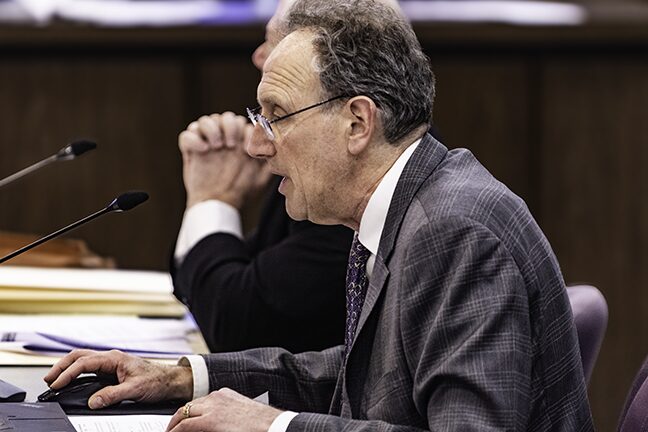
ENGINEERING TESTIMONY – Mitchell Ardman, the engineer for Tahweed Dahwah Center Masjid, testifies at the February 19 Zoning Board of Adjustment meeting.

Zoning Board of Adjustment hearings on a proposal to build a 19,000-square-foot mosque on a 16-acre South Middlebush Road tract resumed on February 19, and all indications are that this will not be a smooth process.

The project’s engineer and architect picked up the testimony where a representative of the Tawheed Dahwah Center Masjid left off in November 2025.

About three dozen neighbors of the proposed mosque showed up to oppose the application, and an attorney representing the Snyder family – whose farm abuts the targeted tract – was also there.

The attorney, Martina Bailie, peppered the two witness and the Board with questions about the application, and repeatedly insisted that the mosque’s representative, Anjum Razi, who did not attend the February 19 meeting, appear at the next hearing to answer questions about the proposed mosque’s operations.

The mosque is working off of a preliminary approval granted by the Board in October 21 for a 21,000-square-foot Hindu temple. The Board set a number of conditions to the preliminary approval; the applicant, Dada Bhagwan Vignan institute, was to have returned to the Board when the conditions were met before it could receive final approval.

But the land and approvals were sold in 2022 for $1.4 million to the Tahweed group, which currently has a temporary meeting space in Edison.

The mosque’s proposal is 2,000 square feet smaller, and the building is designed differently, to accommodate Islamic requirements.

The biggest difference in the two projects is in the intensity of the use; the Hindu temple was going to be used just several days a week, while the proposed mosque would host five prayer sessions every day of the week, in addition to special holy day observances.

Even with the relatively smaller size, the mosque’s square footage caused concern among some Board members and professionals.

Mark Healey, the Township’s principal planner,

Bailie’s questions of Mitchell Ardman, the project’s engineer, revolved around storm water retention, the number of parking spaces needed, and the fact that the mosque’s representative was not at the hearing.

“Just before I get into my questions, am I to understand that because the applicant is not presenting a representative from the organization, any questions that I might have had for the organization, I should redirect to either Mr. Ardman or to anyone else,” she asked.

“This attorney was here in November,” Brian Schwartz, the mosque’s attorney, said. “She sat here while our client testified the entire evening.”

“Excuse me Mr. Schwartz, this was a question for the Board,” Bailie said.

“I understand and I’m anticipating what you’re saying,” Board chairman Robert Thomas said. “I also anticipate that the Board may have a few clarifications from the witness that you’re discussing. So we may ask for that person at some point in the presentation to come back again. But we’re right now dealing only with Mr. Ardman and when he testified.”

“Fair enough, but if we’re going to be deprived of the chance to actually ask questions of the applicant itself, I would like to know that ahead of time because I have questions which maybe Mr. Aardman can answer,” Bailie said. “With all due respect to Mr. Ardman, he’s an expert in his field but he’s not the applicant. So the questions around the usage I think are questions that really have to be answered by somebody.”

Yogesh Mistry, the project’s architect, told the Board that he shaved off some of the rear and side of the original building’s size.

He said the building has a 2,890-square-foot basement, which will be used for storage and utilities.

The worship area is divided into a men’s and women’s area, and the total worship area is 7,981 square feet, Mistry said.

A statement attached to the application said that the mosque would be used for worship at 6 a.m., 1 p.m., 5 p.m., 7 p.m., and approximately 9 p.m., seven days a week, and that each prayer session would last about 30 minutes with between 50-60 people in attendance.

“We have labeled these two spaces, or shown these spaces with three-foot by three-foot boxes,” Mistry said. “Again, these are just kind of representing somebody sitting on the floor because there are no physical seats. And then some aisleways in between. They’re showing on the men’s hall, 288 occupants, and on the women’s hall, 170 occupants.”

The number of people the worship area could accommodate spurred questions from several people, including Richard Procanik.

“I think some of the confusion from the public and from me and maybe the rest of the board members is your floor plan shows up to 458 occupants in the prayer area, so 288, 170, 458,” he said. “Attached to exhibit A1, the statement of proposed use of property indicates that no more than 150 people would be at a service. If I’m saying it incorrectly, please let me know. Why do you need three times the amount of space than the maximum committed area?”

“Our plan wanted to depict what can fit here,” Mistry said. “It’s sort of a capacity drawing. It wanted to show that we’re not exceeding that 458 number.”

“The building is significantly larger because people like the idea of praying in a significant, beautiful place,” Schwartz said.

“I guess the answer to the question, the simple answer is my client was aware that a building had been approved,” he said. “They wanted to match that building as close as possible. They wanted to have a substantial, impressive area in which to worship as they matched it as close as they possibly could.”

Healey said he had the same questions as Procanik.

“So my recommendation has always been to this Board, if an applicant is making representations to something, in this case it’s the 80 people on regular services, 150 for Ramadan, then that application should, and this speaks to Rich’s questions … at least more roughly equate to what they’re proposing,” he said. “If they need a space for 150 worshipers, we brought it up in our staff report, I still don’t understand why they’re proposing a space for three times that. And I also don’t understand why they’re proposing a parking lot that would accommodate for three times that.”

The next hearing on the application is set for April 16.

Stay ‘In the Know,’ subscribe to the Franklin Reporter & Advocate!

No other media outlet covering Franklin Township brings you the depth of information presented by the Franklin Reporter & Advocate. Period. We are the only truly independent media serving the Eight Villages.

But we can only do that with your support. Please consider a yearly subscription to our online news site; at $37 a year, it’s one of the best investments you can make for yourself.

To subscribe, please click here.


Your Thoughts

comments

Check Also

Somerset Fugitive Caught After Three-Hour Standoff On Lenox Place

STREETS CLOSED – Police on February 18 blocked part of Girard Avenue and Clinton Street, …