 The Franklin Reporter & Advocate Eight Villages, One Community
We’ll just come out and say it: The Township Zoning Board of Adjustment should deny the Tawheed Dawah Center’s application to amend the previously approved plans for a house of worship on South Middlebush Road.
And let’s be absolutely crystal clear: the reason is not the religion of the applicant, the beliefs of its prospective congregants nor the number of people who have voiced opposition to the project.
The reason is that the proposed operation represents a substantial departure from the use contemplated in the property’s 2022 preliminary approval, and significant questions about the consequences of that departure have not been satisfactorily resolved.
Those questions involve traffic safety, parking, the proposed frequency of activities and the practical enforcement of restrictions intended to protect public health.
Together, they form a legitimate basis for questioning whether the requested changes should be approved.
And, again, : Muslims, and any other religious group, have every right to establish and attend houses of worship in Franklin Township. Further, opposition based on anti-Muslim prejudice is reprehensible and has no place in this discussion.
But at the same time, legitimate land-use objections should not be dismissed as religious discrimination simply because the applicant is Muslim.
The same questions would be appropriate if the proposed facility were a church, synagogue, temple or any other house of worship. Or any other application, for that matter.
Houses of worship are permitted conditional uses in the Agricultural Zone, and a previous applicant received preliminary approval from the Board for a religious facility on the property in 2022.
That approval came with 39 conditions, including restrictions on attendance, the frequency of gatherings and activities permitted on the property.
The Tawheed Dawah Center now wants to change some of those conditions, most significantly to allow five daily prayer services, seven days a week.
That is a substantially more frequent schedule of activity than the one contemplated in the earlier approval.
We do not question the religious necessity of that schedule. While Muslim prayer practices are not the concern of municipal zoning authorities, the consequences of that schedule for the surrounding community are.
South Middlebush Road is a heavily traveled, two-lane County road. Some would consider it a country road. The applicant’s own traffic study recorded approximately 1,550 vehicles traveling the road during the 5 p.m. peak hour.
The proposed mosque would hold a prayer service at approximately that time, bringing additional vehicles into and out of a new driveway during an already busy period.
The applicant’s traffic engineer has concluded that the additional traffic would have a negligible impact and that the proposed driveway would operate acceptably.
We recognize that New Jersey law does not permit a development to be rejected simply because nearby roads already experience congestion, but we also recognize that there is a meaningful distinction between general congestion and whether a particular driveway can safely accommodate the vehicles entering and exiting a property.
Even Zoning Board Chairman Robert Thomas has said there needs to be a dedicated left-turn lane into the site, although the applicant’s traffic engineer maintains that such a lane is unnecessary.
The applicant has made changes to its plans, including reducing the prayer area to the size approved in 2022, increasing buffering and setbacks and modifying its parking arrangements.
Those changes are welcome, and the applicant deserves credit for making them.
But they do not change the proposed frequency of religious services, which remains the most significant operational difference between the current application and the previous approval.
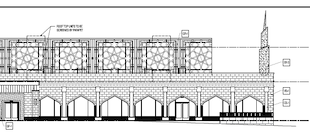
The latest site rendering also proposes holding 60 of the planned 157 parking spaces in reserve, leaving 97 spaces for immediate use.
Such arrangements are permitted under Township ordinances with appropriate approval. Nevertheless, the Board must determine whether the constructed parking would adequately serve the proposed operation, including the building’s consultation rooms, conference room and children’s playroom.
Then there’s the matter of the septic system.
The township’s Technical Review Committee has raised concerns about the facility’s approved limit of 458 people over the course of a day.
The applicant projects ordinary prayer services drawing approximately 50 to 60 people, with larger gatherings during Ramadan and special religious observances.
Although those projections do not establish that the daily septic limitation would be exceeded, with five services each day, along with other proposed activities, the question of how that restriction would be enforced is a legitimate concern.
Thomas raised precisely that issue during the October 15 hearing.
The applicant has pledged to comply with the limitation, and there is no evidence suggesting an intention to violate it.
Still, a pledge is not a substitute for a clear understanding of how an important public health restriction would be administered.
The Board is being asked to authorize a considerably more frequent use of a facility whose daily occupancy is constrained by its septic system. It is reasonable to expect the applicant to demonstrate that the proposed operation can remain within that limitation and that compliance can be addressed through workable conditions.
The revised plans and testimony have addressed some concerns, but the questions surrounding the amended operating schedule, driveway access, parking arrangements and septic limitation remain substantial.
The applicant has the burden of satisfying the legal requirements governing the relief it seeks. The Board should not resolve material uncertainties merely by assuming that problems can be addressed after approval.
And while conditions can properly accompany land-use approvals, they should not become substitutes for evidence establishing that a proposed development satisfies the applicable standards.
Nor should the Board allow the controversy surrounding this application to influence its decision in either direction.
The Board must, and we are confident, will, treat this applicant fairly, as it would any other religious organization, but fairness does not require approval of every requested modification.
Religious freedom deserves vigorous protection, but so does the integrity of the township’s land-use process.
Neither principle requires an approval that the record has not adequately supported.
We believe the requested changes have not been adequately justified by the evidence presented to date, and for that reason, we believe the Zoning Board should deny the amended application.